
Resource · Updated 2026

The Agentic UX Playbook

Design patterns for trustworthy human-AI collaboration

Most AI product advice stops at chat interfaces. Agentic systems are different—they reason, route, act, and escalate. This playbook captures practical patterns from designing ArthurAI, Eve orchestration, and enterprise agentic platforms: how to give AI capability without surrendering human control.

Human-in-the-loop systems

Design so humans stay accountable for consequential decisions.
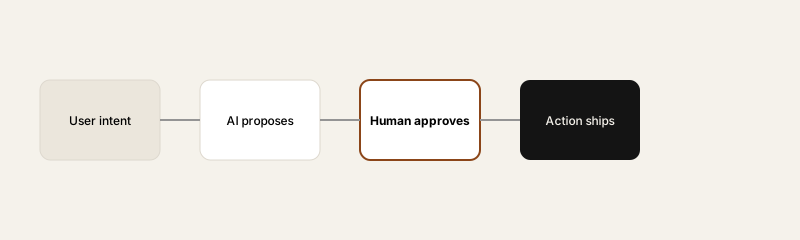
Human-in-the-loop flow: AI recommends, human reviews, then action is committed or rejected
Recommendation and commit are separate steps — humans stay accountable.

Agentic products fail when users cannot tell who is responsible for an outcome. Human-in-the-loop (HITL) design means mapping every AI action to a clear approval, override, or escalation path.

Separate recommendation from commit. AI can draft, rank, route, or analyze—but the interface must show what will happen if the user accepts, and make rejection or edit equally accessible.

Use HITL in regulated domains (education, healthcare, finance), high-stakes workflows, and any system where errors compound across users or institutions.

  • Show AI reasoning at a glance—not a black box, not a full log dump
  • Default to reversible actions before irreversible ones
  • Preserve user agency in the language: "Review and apply" beats "Auto-applied"
  • Design empty, loading, and failure states for human takeover
Bounded agency

Give AI enough autonomy to help, not enough to harm.

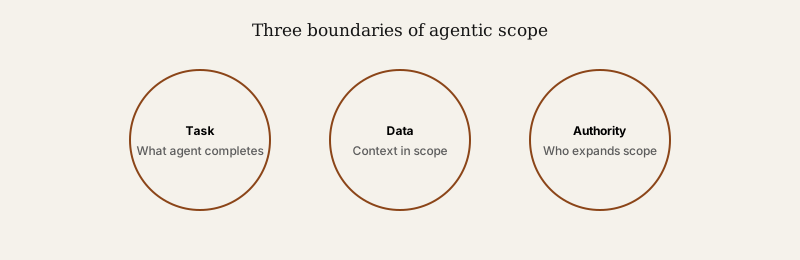
Bounded agency model showing task, data, and authority boundaries for AI agents
Three boundaries — task, data, and authority — keep agents helpful without overreach.

Bounded agency is the design discipline of limiting what an agent can do without explicit scope expansion. Users should understand the perimeter of AI action—the tasks it can initiate, the data it can access, and the point at which it must stop and ask.

Design three boundaries: task (what the agent completes end-to-end vs. hands off), data (what context is in scope and what requires fresh consent), and authority (who can expand scope—user, admin, or system policy).

Avoid “super assistant” UX that implies unlimited capability. Prefer capability cards—visible scopes the user can enable, disable, or time-limit.

AI trust patterns

Trust is built through predictability, not polish.

Trust layers diagram: provenance, consistency, recoverability, and honest limits
Trust patterns compound over sessions — design for repeat use, not the demo.

Users trust AI products that behave consistently—not ones that merely look futuristic. Trust patterns are repeatable UI conventions that signal reliability over time.

Essential patterns include provenance (where output came from), consistency (same action, same controls), recoverability (undo and audit trail), and honest limits (“I don’t have enough context” beats a confident wrong answer).

Trust erodes silently. Design for the second session, not the demo.

Escalation design

Plan for when AI should stop and involve a human.

Escalation is not an error state—it is a designed transition. Every agentic workflow needs explicit triggers: low confidence, policy conflict, user request, or out-of-scope intent.

Design an escalation ladder: self-correction, user clarification, human handoff, and system halt with preserved state.

When escalating, the human receiver needs summary, history, attempted actions, and recommended next steps—not a raw chat transcript.

AI transparency

Make system behavior legible without overwhelming users.

Transparency is progressive disclosure of how the system works. Users need different depth at different moments—a student checking a grade needs less than an administrator auditing policy compliance.

Design three layers: at action time (what will happen if I proceed?), at review time (why did the system suggest this?), and at audit time (full trace for compliance).

Avoid transparency theater—long explanations nobody reads. Use structured summaries, expandable detail, and consistent metadata.

Multi-agent workflows

Orchestration UX for systems where multiple agents collaborate.

When multiple agents collaborate, users need a mental model of who is doing what. Without orchestration visibility, multi-agent systems feel chaotic—even if the backend is elegant.

Use a single thread with multiple actors, explicit handoffs when one agent passes to another, shared context indicators, and conflict resolution UI when agents disagree.

The meta-orchestrator pattern is a product surface, not just infrastructure.

Building an agentic product?

I help teams design human-AI workflows that ship—with patterns like these grounded in real institutional deployments.

Open to opportunities

Interested in working together?

Open to remote and hybrid AI Product Design roles—full-time, contract, and advisory. Based in Lahore, working with teams worldwide.

  • Full-Time
  • Contract
  • Advisory

hello@imranirfani.com · Lahore, Pakistan